

Amboise is one of the most-visited towns in France’s UNESCO-listed Loire Valley. The historic town is home to several castles, but that’s not all! For a town of such a modest size, there are a surprising number of things to see in Amboise, including beautiful architecture, archaeological sites and, of course, the stunning banks of the Loire.
Today, Amboise is located in the French department of Indre-et-Loire in the Centre-Val de Loire region, and still bears the imprint of the wealth and power that were once concentrated in the Loire Valley.

Amboise is most famous for the Château Royal d’Amboise (Royal Castle of Amboise), which once housed the kings of France, and the Château du Clos Lucé (Clos Lucé Castle), which served as the home of Leonardo da Vinci in his later years.
Contents
- How long to stay in Amboise?
- What to see in Amboise – Top 28 sights
- 1. Château Royal d’Amboise (Royal Castle of Amboise)
- 2. Château du Clos Lucé (Clos Lucé Castle)
- 3. Domaine Royal de Château Gaillard (Royal Domain of Gaillard Castle)
- 4. Place Michel Debré (Michel Debré Square)
- 5. Tour de l’Horloge (Tower of the Clock)
- 6. Maison Bigot
- 7. Rue Nationale (National Street)
- 8. Musée d’Art et d’Histoire d’Amboise (Museum of Art and History of Amboise)
- 9. Église Saint-Florentin d’Amboise (Saint Florentin Church of Amboise)
- 10. Crinkly de Calder (Crinkly by Calder)
- 11. Marché d’Amboise (Amboise Market)
- 12. Fontaine Max Ernst (Max Ernst Fountain)
- 13. Banks of the Loire
- 14. Remnants of the World War II temporary footbridge
- 15. Île d’Or (Island of Gold)
- 16, Leonardo da Vinci statue
- 17. La Tour d’Or Blanc (The Tower of White Gold)
- 18. Église Notre-Dame-du-Bout-des-Ponts (Notre-Dame-du-Bout-des-Ponts Church)
- 19. Chapelle Saint-Jean (Saint Jean Chapel)
- 20. Pagode de Chanteloup (Chanteloup Pagoda)
- 21. Église Collégiale Saint-Denis d’Amboise (Saint Denis Collegiate Church of Amboise)
- 22. Panorama at 3 rue Léonard Perrault
- 23. Caves Ambacia (Ambacia Cellars)
- 24. Oppidum des Châteliers (Oppidum of the Châteliers)
- 25. Butte de César (Mound of Caesar)
- 26. Rempart gaulois (Gallic Rampart)
- 27. Bois de la Moutonnerie (Woods of the Moutonnerie)
- 28. Parc des Mini-Châteaux (Park of the Mini Castles)
- Day trips from Amboise
How long to stay in Amboise?
Some people visit Amboise as a day trip from major cities like Nantes, Saint-Nazaire or even Paris. However, if you are travelling through the Loire Valley, you will need at least several days to visit a selection of towns and castles in the area.
If you are visiting only Amboise, I would spend a minimum of one or two days exploring the main sights in town and the castles. If you wish to visit multiple other towns in the Loire Valley such as Blois, Tours, Saumur and Angers, I would plan for a trip of at least three days. That said, you could easily spend a week or more in the area visiting multiple cities and castles. It all depends on how long it takes you to get castled out.
As one of the most important historic towns in the UNESCO-listed area of the Loire Valley, and one of the richest in terms of sights, Amboise has a wide selection of accommodation and makes a good base from which to undertake day trips to Blois, whose castle and town are worth a full day of exploration, and famous castles such as the otherworldly Château de Chenonceaux (Chenonceaux Castle), Château de Chaumont-sur-Loire (Chaumont-sur-Loire Castle), Château de Chambord (Chambord Castle) and Château de Cheverny (Cheverny Castle).
What to see in Amboise – Top 28 sights
I’ve tried to arrange this list of Amboise sights in order of importance to make it easy to decide what to see for those who are pressed for time. Let’s get into it!
1. Château Royal d’Amboise (Royal Castle of Amboise)

The Château Royal d’Amboise (Royal Castle of Amboise), also known simply as the Château d’Amboise (Amboise Castle), fell into the hands of royalty in 1434 and served as the residence of the kings of France during the Renaissance period, including Charles VII, Louis XII and François I.
It was previously known for being one of the most secure and protected castles in the west of France. The castle grounds are extensive and there are many buildings to explore, including the flamboyant Gothic Chapelle Saint-Hubert (Saint Hubert Chapel), where the tomb of Leonardo da Vinci is located.
2. Château du Clos Lucé (Clos Lucé Castle)

The Château du Clos Lucé (Clos Lucé Castle) is best known for being the last residence of Leonardo da Vinci before his death in 1519.
King François I gave Leonardo da Vinci the right to live and work in the Château du Clos Lucé (Clos Lucé Castle) after his departure from Rome. There, he worked as an artist, engineer and architect. Reproductions of some of his projects are displayed at the castle. The property also houses a huge garden where life-size models of some of his inventions can be found.
3. Domaine Royal de Château Gaillard (Royal Domain of Gaillard Castle)

Amboise is home to a third castle, the Château Gaillard (Gaillard Castle), whose claim to fame is its Italian-inspired style. I use the term here loosely, as the word château (castle) is often used to refer to large buildings or estates rather than actual castles.
As the story goes, King Charles VIII led a military campaign in Italy in 1496. He was so impressed by the beauty of Italy that he came back with 22 Italian artists, determined to recreate a French version of the Italian Renaissance that so inspired him.
One of the estate’s most noteworthy features is its sprawling Italian-style gardens, dubbed les Jardins du Roi (the Gardens of the King).
4. Place Michel Debré (Michel Debré Square)

Place Michel Debré (Michel Debré Square) is the most central and the most important town square in Amboise. Located at the base of the Château Royal d’Amboise (Royal Castle of Amboise), it is the town’s main focal point and contains its highest concentration of restaurants and bakeries.
5. Tour de l’Horloge (Tower of the Clock)

This 15th-century tower, which overlooks Rue Nationale off Place Michel Debré (Michel Debré Square), was built into the ancient city walls, and previously served as a gateway to historic Amboise.
6. Maison Bigot

Maison Bigot is the most famous bakery in Amboise. The family-owned business has been in operation for over 110 years. They serve up a delectable selection of cakes, pastries, and chocolate, and also have an in-house dining area. If you’re looking for a quick meal to-go, they also make decent sandwiches.
7. Rue Nationale (National Street)

Rue Nationale (National Street) is one of the main commercial thoroughfares in Amboise’s historic centre. It goes under the arches of the Tour de l’Horloge (Tower of the Clock). It’s worth taking a walk down this street to check out the town’s major restaurants and shops.
8. Musée d’Art et d’Histoire d’Amboise (Museum of Art and History of Amboise)

This small museum is located in a 16th-century building called the Hôtel Morin (Morin Hotel), built by a wealthy merchant who served as treasurer to Louis XII, and later used as the town hall of Amboise. The exhibits are a mishmash of artwork and artefacts related to Amboise, including objects from the town’s older postal services and the pistols used in the duel that killed Russian writer Alexander Pushkin.
It’s free to visit, but opening hours vary, so check the schedule ahead of time.
9. Église Saint-Florentin d’Amboise (Saint Florentin Church of Amboise)
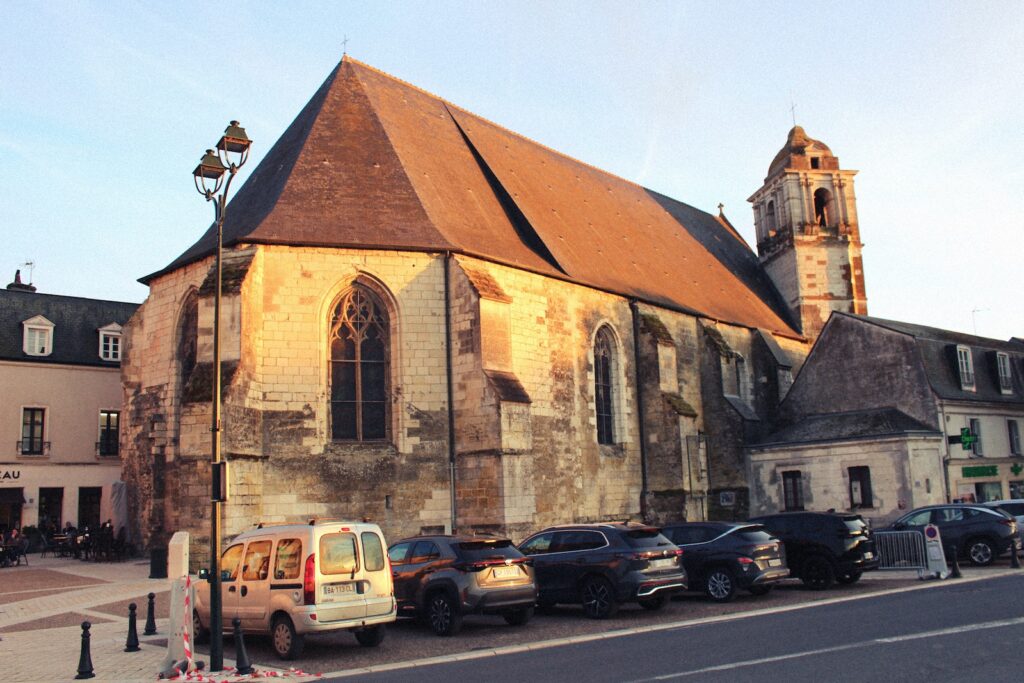
Église Saint-Florentin d’Amboise (Saint Florentin Church of Amboise) is situated in the town centre near the Loire, and is one of Amboise’s two parish churches. It was built in the late 15th century, but the roof of the bell tower was altered according to the Renaissance style in the 16th century.
10. Crinkly de Calder (Crinkly by Calder)

This contemporary sculpture, Crinkly, is located in the square right in front of the Église Saint-Florentin d’Amboise (Saint Florentin Church of Amboise) on Rue François 1er. It is a work of celebrated American sculptor Alexander Calder, known for his moving sculptures and mobiles. The upper part of the sculpture captures the wind to produce movement.
11. Marché d’Amboise (Amboise Market)

Most French communes have a market on certain mornings of the week, but the Marché d’Amboise, which takes place on Sundays from 8am to 1pm, is special because it is huge, especially for a town of this size, and features a diverse selection of ready-to-eat meals and snacks, produce, clothes and other random products. People from other communes in France travel to Amboise just for the market! It’s a great place for an affordable meal or artisanal edible gifts.
12. Fontaine Max Ernst (Max Ernst Fountain)
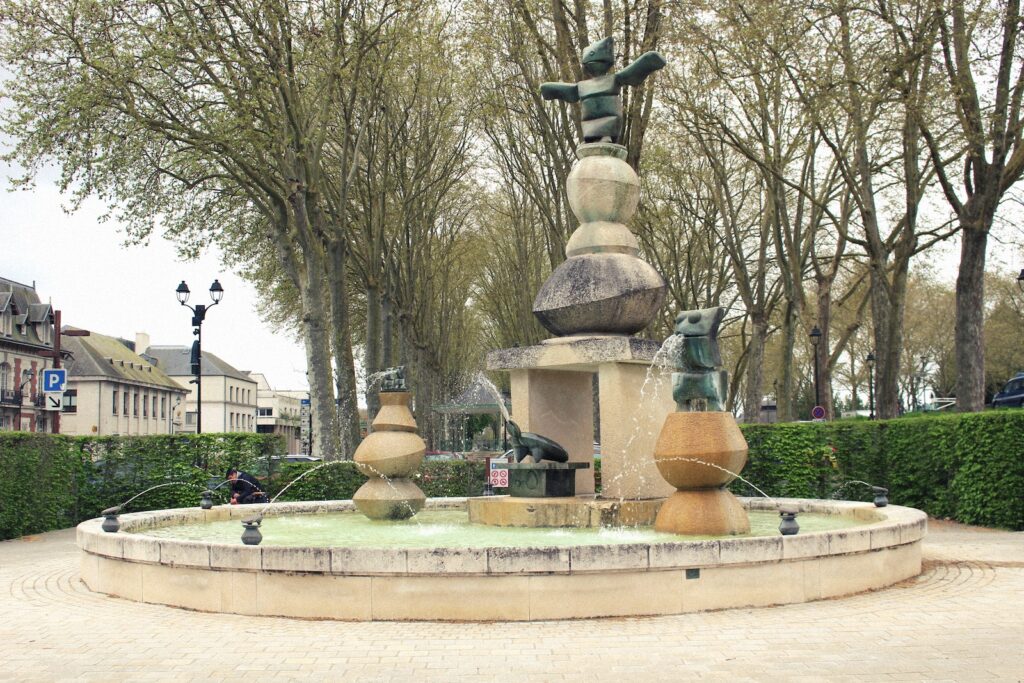
A stone’s throw from the site of the Marché d’Amboise (Amboise Market), at the intersection of Chemin de l’Abattoir and Quai du Général de Gaulle, is the wacky and whimsical Fontaine Max Ernst (Max Ernst Fountain), a surrealist curiosity that both bewilders and amuses. The sculpture features tortoises and frogs and is crowned by a genie. Its official name, “Aux cracheurs, aux drôles, au génie” (To the spitters, to the strange, to the genius/genie), doesn’t really make sense when translated.
13. Banks of the Loire

You can’t visit Amboise without taking a stroll along the banks of the Loire River. The town was built along the south bank of the Loire, with the Château Royal d’Amboise (Royal Castle of Amboise) looking down imposingly over the river. The best views of the castle can be seen from the Pont du Maréchal Leclerc (Marshal Leclerc Bridge).
14. Remnants of the World War II temporary footbridge

From Quai Charles Guinot (Charles Guinot Quay), you can spot the remains of the concrete piers of a temporary World War II footbridge. In 1940, Amboise’s main stone bridge was destroyed to slow down advancing German troops, and this temporary bridge was built in its place to grant passage across the Loire.
15. Île d’Or (Island of Gold)

Île d’Or (Island of Gold), also known as Île Saint-Jean (Saint Jean Island), is a natural island measuring about 2 km, offering stunning views of the Château Royal d’Amboise (Royal Castle of Amboise) and a beautiful stroll along the banks of the Loire. This post’s cover photo was taken from the spot in the picture above! Île d’Or (Island of Gold) is also visited by locals for its recreational facilities, which include a campsite and mini-golf course.
16. Leonardo da Vinci statue

From the town centre of Amboise, take Pont du Maréchal Leclerc (Marshal Leclerc Bridge) and turn right on Quai François Tissard (François Tissard Quay) once you hit the Île d’Or (Island of Gold). Walk for two or three minutes and you’ll come across an evocative statue of Leonardo da Vinci in contemplation on the banks of the Loire. This spot also offers one of the best views of the Château Royal d’Amboise (Royal Castle of Amboise).
17. La Tour d’Or Blanc (The Tower of White Gold)

This imposing sculpture by Jean Michel Othoniel was commissioned by a group of winegrowers with the goal of indicating an entry point into Amboise and also unifying the town centre with the Île d’Or (Island of Gold). The glass of the lantern at the top of the pole is a nod to glass bottles stored in wine cellars.
18. Église Notre-Dame-du-Bout-des-Ponts (Notre-Dame-du-Bout-des-Ponts Church)

This former 16th-century church, built on the Île d’Or (Island of Gold), has been damaged many times by the overflowing of the Loire.
19. Chapelle Saint-Jean (Saint Jean Chapel)

If you venture further from the bridge on the Île d’Or (Island of Gold), at the far end, you’ll come across the Chapelle Saint-Jean (Saint Jean Chapel), which is all that remains of a 12th-century monastery.
20. Pagode de Chanteloup (Chanteloup Pagoda)

This 40-metre Chinese-style pagoda lies in the heart of a sprawling park measuring 14 hectares. Built in the 18th century, it was an extravagant addition to the domain of the Château de Chanteloup (Chanteloup Castle), which was dismantled in the 19th century when it was sold by its owner in order to pay off debt.
You can climb up the pagoda for panoramic views over Amboise and the surrounding forest, as well as visit the park, which comprises a Chinese garden. You can reserve tickets in advance online.
21. Église Collégiale Saint-Denis d’Amboise (Saint Denis Collegiate Church of Amboise)

This church was formerly a collegiate church, meaning it was not the main church for locals, but for clergy who were not monks. It later became a parochial church after the French Revolution, which means it was meant to serve the local community. Construction of the church began in 1108.
22. Panorama at 3 rue Léonard Perrault

It’s quite a climb to get to this viewing deck at 3 rue Léonard Perrault, but the panoramic views over the town are worth the effort! From Rue Victor Hugo, follow the slopes and the steps up to the top.
23. Caves Ambacia (Ambacia Cellars)

There are countless wine cellars in the Loire Valley. Caves Ambacia (Ambacia Cellars) is one of the more well-known ones in Amboise, and offers tours of the wine cellars as well as an in-house bistro, L’Oppidum.
24. Oppidum des Châteliers (Oppidum of the Châteliers)
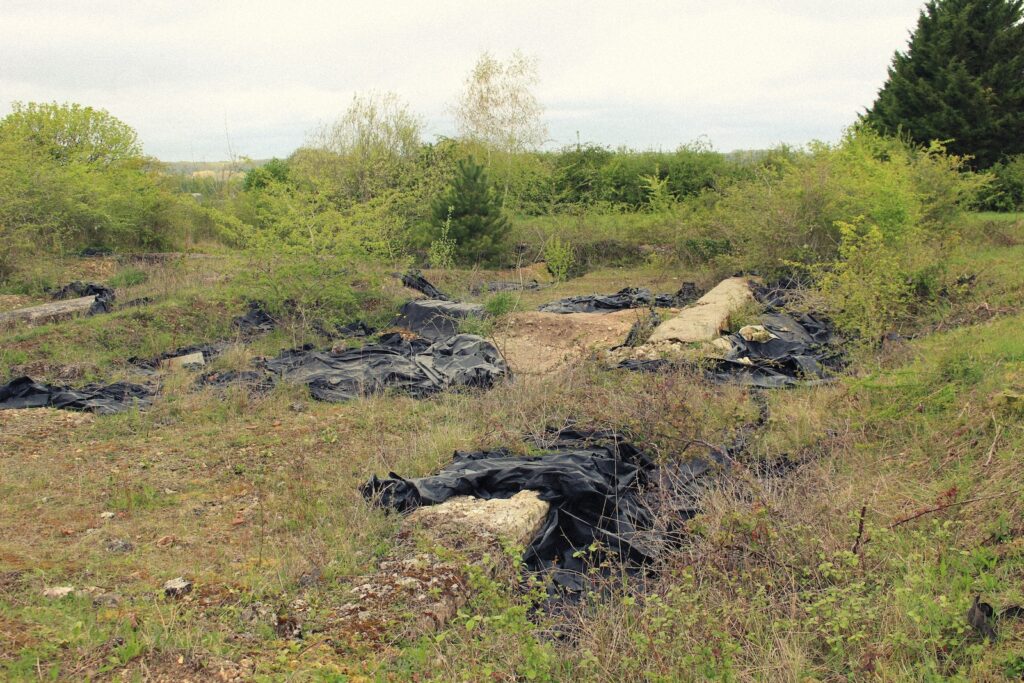
Most visitors don’t know that Amboise is also home to some interesting archaeological sites, reachable on foot from the town centre. Amboise is located on a plateau called the Plateau des Châteliers (Plateau of the Châteliers), which was continuously inhabited from the Neolithic to the 4th century. Remains of the oppidum, or the Iron Age Gallic settlement, can be seen in the field at the intersection of Rue Rouget de Lisle, Rue Augustin Thierry and Rue des Châteliers.
25. Butte de César (Mound of Caesar)

A little further east from the Oppidum des Châteliers (Oppidum of the Châteliers), on Rue Augustin Thierry to the east of Rue Rouget de Lisle, you can see the Butte de César (Mound of Cesar), which is believed to be a princely burial mound used during the first Iron Age, from approximately 800 to 500 BC.
26. Rempart gaulois (Gallic Rampart)

A little further down on Rue Augustin Thierry, to the east of the intersection with Rue du Vallum, you’ll see the Rempart gaulois (Gallic Rampart), the remains of the city walls of the Gallic town formerly known as Ambacia, built to defend the town about 2,100 years ago.
27. Bois de la Moutonnerie (Woods of the Moutonnerie)

While Amboise has a huge forested area of over 6,000 hectares, most of it is privately-owned. Only about 120 hectares, located in the Bois de la Moutonnerie (Woods of the Moutonnerie), belong to the municipality and are open to the public. The woods are also home to an artificial lake that attracts picnickers in summer.
28. Parc des Mini-Châteaux (Park of the Mini Castles)

This theme park features over 40 miniature replicas of famous French castles and is mainly visited by families with kids.
Day trips from Amboise
- Amboise is a quick train ride away from major cities in the UNESCO-listed Loire Valley, including Tours, Blois, Orléans, Saumur and Angers.
- Other famous castles near Amboise include those at Chaumont-sur-Loire, Chenonceaux, Cheverny, and Azay-le-Rideau, all of which can be reached by train and/or bus.
- Amboise is also reachable in about two hours by train from Nantes, France’s sixth largest city.

1 Comment
Pingback: 35 Best Things to See in Angers (According to a Local) - France with Jo